Author: Estelle Paulus (Oxford).
Our global agrifood systems (AFSs) are facing unprecedented challenges. From the increased frequency and intensity of extreme weather to geopolitical conflicts, the stability of food production and access is increasingly under threat. Such shocks can have severe, far-reaching impacts, potentially triggering food crises that affect everything from individual livelihoods to global supply chains.
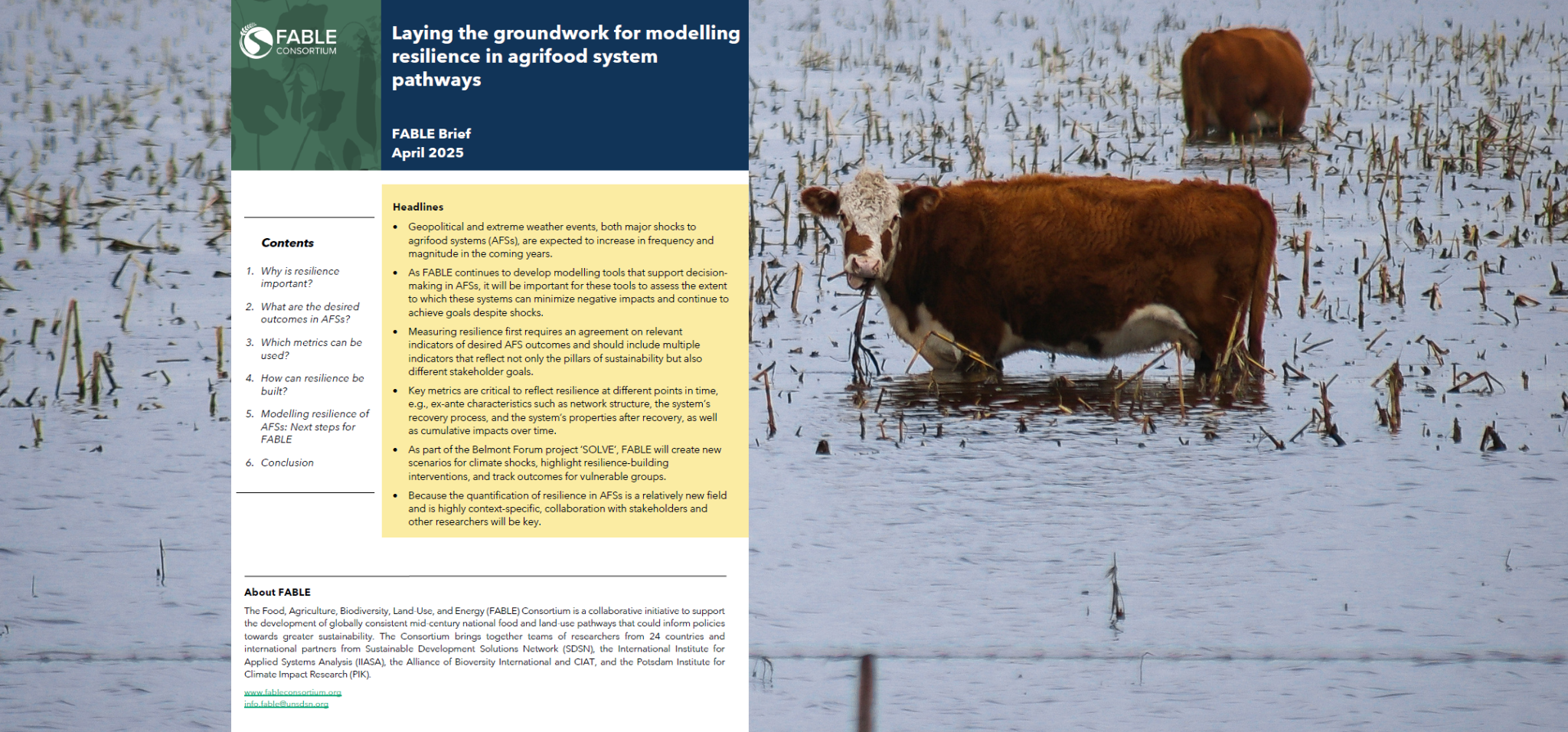
Incorporating resilience considerations into AFS models on a global scale is still a relatively new field. The latest FABLE brief 'Laying the groundwork for modelling resilience in agrifood systems pathways' outlines key concepts, metrics, and next steps for incorporating resilience into the FABLE framework and supports decision-makers in navigating an increasingly volatile world.
What is AFS resilience?
The brief defines a system's resilience as its dynamic capacity to prevent negative impacts and continue to achieve goals despite disturbances and shocks. Put simply, resilience is a system's ability to preserve, recover, and reorient itself to maintain desired outcomes even after being hit by disruptions. In contrast with merely bouncing back, a resilient system leverages three capacities comprising absorptive coping, adaptive capacity, and transformative capacity. Furthermore, resilience is complementary to sustainability, as a system cannot be resilient if it is not sustainable over time. Hence, defining resilience begins with defining desired long-term outcomes against which AFS performance can be measured.
Measuring what matters: Outcomes and metrics
AFS outcomes vary widely and extend beyond food security or production volumes; they need to reflect the full spectrum of sustainability, including food and nutrition security, social, economic, and environmental outcomes, and consider the diverse goals of different stakeholders. The brief points to the UN Sustainable Development Goals (SDGs) and the Doughnut Economics framework as useful guides for realizing human thriving within planetary boundaries.
Once desired outcomes are defined, the next step is to develop appropriate metrics to measure system performance under different development pathways and shock scenarios, and at different points in time. Drawing from literature on resilience curves (illustrating performance before, during, and after a disruption), the brief presents some commonly employed ex-post metrics – measures taken after a shock has occurred, capturing robustness, absorption capacity, adaptive capacity and flexibility, transformative capacity, and cumulative resilience.
Furthermore, ex-ante assessments (i.e. looking at system characteristics before a shock hits the system) are crucial for decreasing vulnerability and widening the decision space of stakeholders, which can become limited by the increasing severity and likelihood of risks. Indicators may capture exposure, vulnerability, and inherent capacities and may include food stock levels, infrastructure (such as mobile coverage or road density), the Social Capital Index, and the Agrobiodiversity Index.
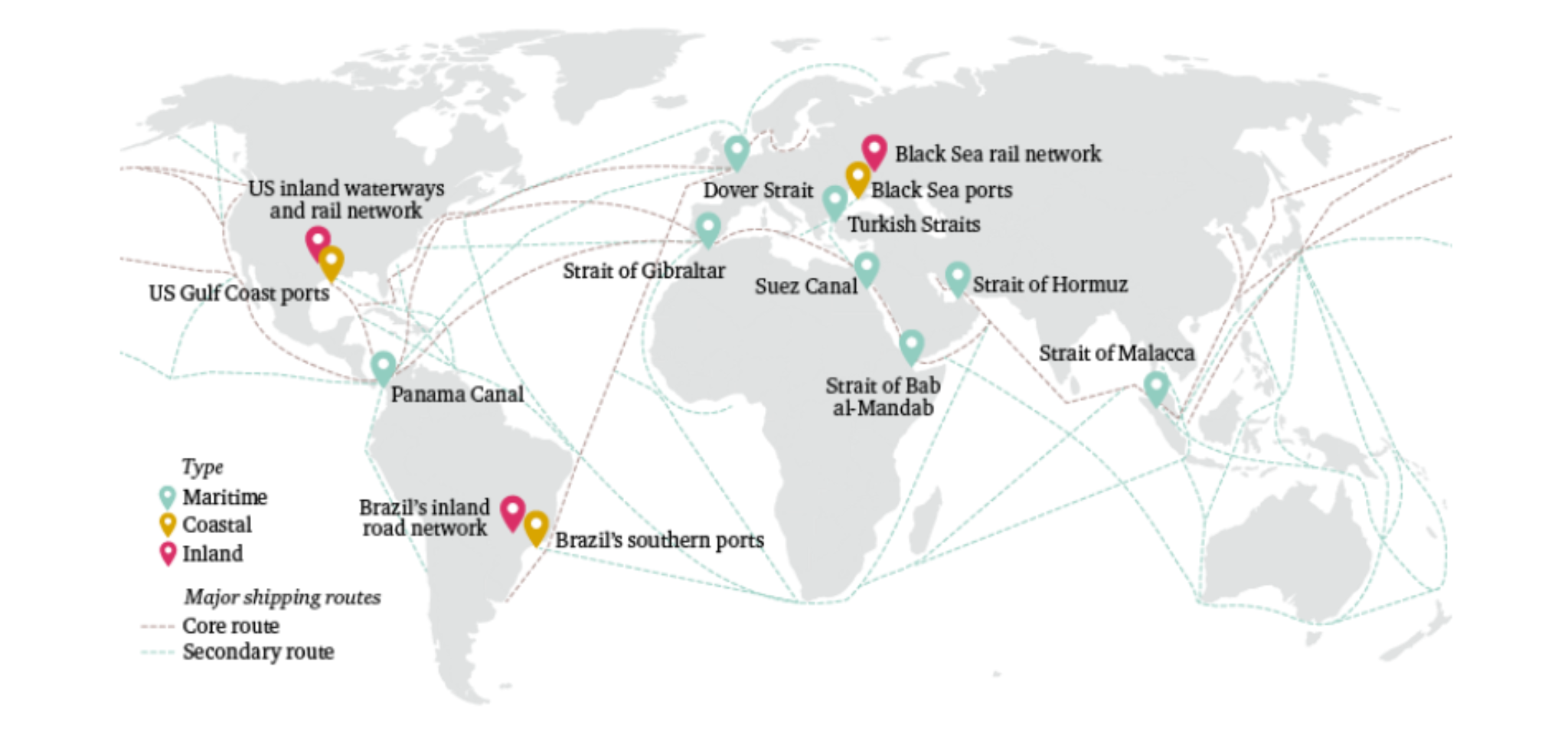
Major trade choke points for global food systems. Source: Bailey and Wellesley (2017), adapted from Rodrigue, J.P., and Slack, B. (2017), building on trade data from the Chatham House Resource Trade Database.
The challenge of interconnectedness
Agrifood systems are not isolated entities; they are highly interconnected globally. Shocks in one area or sector can quickly have knock-on effects elsewhere. For instance, the conflict in Ukraine severely impacted global grain markets both because of the country’s significant share of global production and the damage inflicted on key infrastructure.
Measures of resilience must recognise this interconnectedness and the transmission of risk across regions. Network structures play a significant role in how systemic risks manifest. Factors like increased system size, reduced redundancy, and denser networks can lead to greater instability. Furthermore, the reliance on critical trade chokepoints for global food flows can pose serious risks in the case of disruption. It's vital to understand how compounding events, like simultaneous production failures in major breadbaskets, can create systemic threats. As such, network analyses are essential tools for assessing these risks.
Building resilience: Ex-ante action is key
While responding after a shock (ex-post measures) can be effective for one-off events, these become very costly when shocks are recurring, simultaneous, or compounding. Ex-ante long-term planning, restructuring, and monitoring— i.e., actions taken before a shock—are expected to bring greater savings over time.
Building resilience is about guiding the system towards a more sustainable and resilient state by enhancing interactions between actors, implementing measures to absorb or adapt to shocks, and making transformative changes. Navigating power dynamics among actors across food systems, like large corporations and smaller producers, remains a challenge to implementing some of these changes. Here, public policy plays a critical role in supporting or hindering these efforts. This brief presents a short overview of example interventions that can increase resilience in AFSs.
FABLE's next steps in modelling resilience
The next steps for integrating resilience into the FABLE framework involve:
• Incorporating shock scenarios: The FABLE database will be updated to include new scenarios reflecting shocks and stressors with an initial focus on climate extremes, as part of the SOLVE project. We are also projecting future bilateral trade flows and testing the propagation of shocks for different trade strategies.
• Identifying promising resilience-building interventions: FABLE will work closely with stakeholders in nine countries to identify effective resilience-building interventions.
• Monitoring desired outcomes: FABLE models provide multi-objective assessments covering indicators like food security, GHG emissions, biodiversity, water, land use, and trade. FABLE will adapt tools to specifically monitor outcomes for target vulnerable groups, such as livestock farmers, migrants, or consumers living in remote areas.
By measuring responses to systemic shocks and identifying resilience-building scenarios, we aim to support decision-makers in creating more sustainable AFSs. Incorporating resilience metrics in AFS models can inform stress-testing frameworks, extract lessons from past crises, and guide financing strategies for resilience. This brief marks an initial step toward using the FABLE framework to help decision-makers better understand, measure, and strengthen the resilience of our agrifood systems in the face of future shocks.
Tweet